


Against the Algorithms: Why High-Friction, Human-First Marketing is the Way to Win Attention
For a decade, the formula for organic growth in a startup was a simple, scalable machine: Content + SEO = Traffic = Leads.
You hired a content team, wrote highly researched articles answering common customer questions ("How to integrate X with Y"), and leveraged Google's vast, open index to vacuum up users seeking "helpful" information. The strategy was successful precisely because it was scalable and automatable.
That era is over.
Welcome to the "Dead Internet", a landscape increasingly filled with high-quality, synthetic, and often indistinguishable content. The signal-to-noise ratio has never been worse, and the platforms themselves are making it harder to win attention.
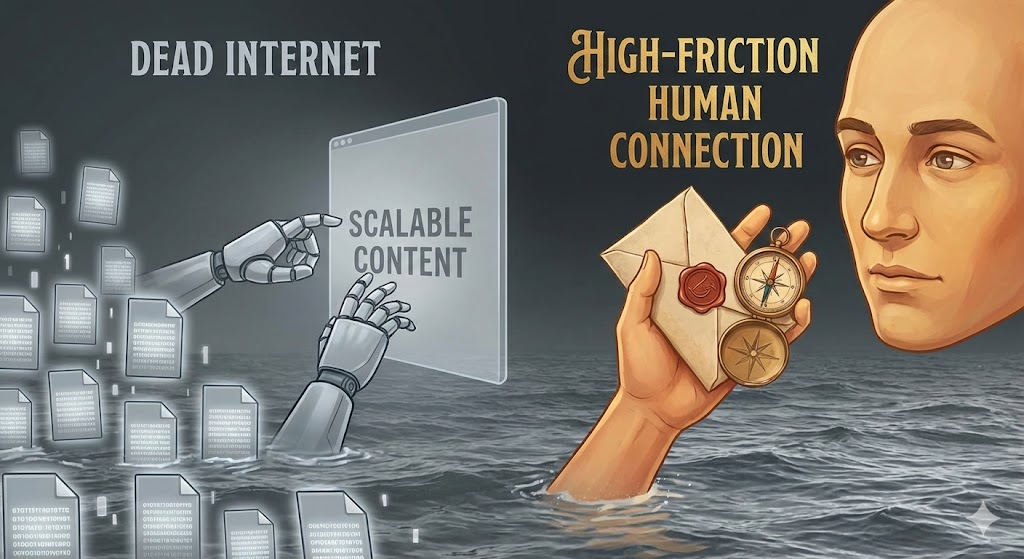
The shift is driven by two concurrent threats:
AI Commoditization: Large Language Models (LLMs) can now generate high-quality blog posts, social updates, and ad copy faster and cheaper than any human.
Search Generative Experience (SGE): Google and other search engines are integrating AI directly into the results. If a user asks, "How to write a complex SQL query," the AI provides the answer immediately in the search result block, eliminating the need to click through to your domain.
If your core organic strategy relies on answering common questions or providing "helpful" summaries, your content is now functionally irrelevant. It has been outsourced to a chatbot.
For the modern, resilient founder, the solution is counter-intuitive: You must pivot away from the scalable, easy actions toward High-Friction Marketing. You must trade the promise of unreliable, exponential growth for the certainty of high-quality, human-validated, and defensible relationships.
This means doing things that are hard to do, impossible to fake, and instantly signal human conviction.
1. The Collapse of the Scalable Content Model
The traditional funnel of "attract broad audience via SEO, then filter them down to a customer" is collapsing at the top.
SGE: The Search Result as the Answer
Google's evolution is the most immediate threat. SGE, or similar AI-driven result blocks, aims to provide immediate, definitive answers. For the user, this is a massive productivity gain. For the publisher—the startup relying on organic traffic—it's an existential crisis. Your domain used to be the answer; now it’s merely a tiny citation at the bottom of the AI-generated summary.
The Cost of Synthetic Content: The volume of AI-generated content has pushed the quality of everything else down to a commodity level. It is cheap to produce, but it is expensive to consume because it requires the user to filter out the generic, synthesized sludge. The market is training itself to ignore the "average" answer, regardless of whether it was written by an LLM or a human trying to game the SEO system.
The Founder Takeaway: Every dollar your team spends on mass-produced, neutral content that could be written by an Agent is a poor, high-risk investment. Your marketing must pivot from description (what your product does) to disruption (why your industry is wrong).
2. Moat 1: Opinion is the New SEO
In a world drowning in synthesized consensus, the ultimate scarcity is a strong, convicted human point of view.
AI models are designed for neutrality and risk-aversion. They optimize for the median, the average, the consensus answer. They cannot take a stand, push back against dogma, or advocate for a polarized position. This psychological void is where the founder must step in.
The Founder as the Chief Contrarian
Your job is to cultivate and communicate a unique, specific, and often polarized opinion about your industry, your customers, or your competitors. This is the new way to generate earned media and organic inbound traffic.
The Conviction Economy: Strong opinions cut through the noise because they force a reaction. They generate two types of high-quality traffic:
Enthusiastic Agreement: People who instantly understand your core thesis and become highly qualified, mission-aligned customers.
Thoughtful Disagreement: People who engage, debate, and share your content because they are interested in the intellectual friction.
Examples of High-Friction Opinion:
Instead of: "5 Ways to Improve Cloud Security."
Try: "Why Multi-Cloud is a Myth, and You Should Be Running 100% on a Single Provider (We Chose GCP and Here’s Why)."
Instead of: "Guide to Q4 Marketing Budgets."
Try: "The Most Popular Metric in B2B SaaS (CAC) is a Lie, and We’ve Stopped Tracking It."
This approach makes your founder instantly unignorable, and, crucially, un-automata-ble. You are building an intellectual moat around your brand that only another human with equal conviction can challenge.
3. Moat 2: High-Friction, Analog Engagement
If AI makes digital interaction cheap and abundant, then anything that requires a high physical or time commitment instantly becomes high-value and scarce. This is the core principle of High-Friction Marketing.
The Return of Physical Direct Mail
In an age where inboxes are flooded and email open rates hover near 20%, the open rate for a personalized, physical package is near 100%.
The Strategy: Do not send mass-produced brochures. Focus your budget on your top 100 Ideal Customer Profile (ICP) accounts.
Hyper-Personalized Swag: Send a high-quality, custom-designed item related to your product's benefit (e.g., a branded, custom-engraved Moleskine for a productivity app founder, or a niche piece of hardware for a developer).
Handwritten Letters: A genuine, handwritten note from the founder referencing something specific about their company (a recent funding round, a new product launch) cannot be replicated by an Agent and immediately signals that the recipient is important.
The Dinner Party Strategy
Stop spending six figures on massive conference sponsorships where you get three random leads. Instead, spend that money on curating small, intimate events.
The Curated Dinner: Host a dinner for 6-8 target executives or high-value founders in your vertical. The goal is to facilitate genuine peer-to-peer discussion, not to pitch your product. The environment (fine dining, a unique experience) acts as a powerful memory anchor.
The Unscalable Product Feature: Go one step further: turn your product into a marketing asset by adding high-friction, personalized touches for early users. Make a commitment that the CEO (or the most senior founder) will personally conduct the first three onboarding sessions for every new enterprise customer. This is unscalable, but it generates incredible early trust, retention, and word-of-mouth.
The key insight here is that you are replacing marketing spend with a relationship investment. A personalized $100 gift or a $1,000 dinner that nets one highly engaged, long-term customer is infinitely more valuable than $10,000 in Google Ads that yields 50 cold leads.
4. Moat 3: Winning in Dark Social and Closed Communities
The communication pendulum is swinging from public, open social feeds (where content is indexed and commoditized by AI) to Dark Social—closed, private environments where real vetting occurs.
Trust by Proxy in Private Spaces
The most valuable conversations—the ones that lead to multi-million dollar deals—are happening in private Slack groups, encrypted messaging apps, niche paid newsletters, and secure Discord servers.
Why it Matters: In a closed community, content is shared based on trust and relevance ("Trust by Proxy"). If a peer in a private CEO Slack group recommends your product, that referral is worth 10,000 cold email sequences.
The Niche Sponsorship Strategy: Move your ad spend from generalized platforms (LinkedIn/Google) to sponsoring hyper-niche, highly vetted communities and newsletters. Look for the small, exclusive Substack, the industry-specific Discord, or the gated Slack group where your ICP truly congregates. The audience size is small, but the quality and conversion rate are exponentially higher.
The Founder’s Role: Show Up as a Peer
To succeed in Dark Social, the founder cannot send a marketing team or deploy a bot. You must show up yourself.
Authentic Contribution: Your goal is to enter these communities as a genuine peer who offers help, answers complex technical questions without expectation of a sale, and builds a reputation for expertise. You are selling your mind and your knowledge, not your product features.
Listening for Signals: These closed channels are also the ultimate source of market intelligence. They reveal customer pain points, competitor weaknesses, and product desires in raw, unfiltered language that you will never find in a survey. Treat participation not as marketing, but as high-fidelity customer development.
Trading Scale for Sovereignty
The "Dead Internet" is not a landscape to fear; it is a landscape that demands discipline and conviction.
The old marketing formula traded quality for scale, resulting in high burn and commoditized results. The new marketing formula trades scale for Sovereignty: a high-quality, human-validated customer base that provides superior retention, higher LTV, and a more resilient path to MVR.
Your marketing moat is built not on automation, but on the three things AI cannot replicate: Strong Human Opinion, High-Friction Effort, and Genuine Trust.
The era of easy digital growth is over. It’s time to embrace the hard work—because that's the only work that matters.
10th December 2025