


Startup Things: Vol 3 | The Starcourt Siege
It’s the summer of 1985 in Hawkins. The air is thick with the smell of hairspray and New Coke. The kids are growing up, falling in love, and—most importantly—everyone is hanging out at the brand-new Starcourt Mall. It’s flashy, it’s modern, and it’s effectively killing every "Main Street" business in town.
Welcome to the Series B/C Expansion phase of your startup.
In Volume 1 and 2, you were the underdog. You were hidden in a basement, fighting monsters that most of the world didn't even believe existed. But now, you’ve hit a certain level of scale. You aren't a secret anymore. You’ve occupied a piece of the market, and you’re making enough noise that the "Adults" (incumbents and Big Tech) have finally noticed you.
And they aren't happy.
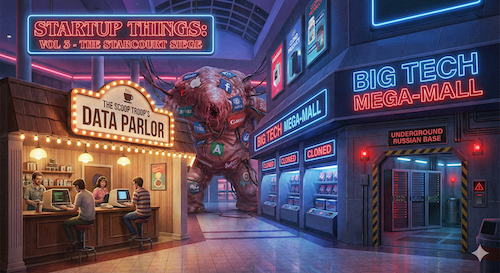
When a multi-billion-dollar incumbent sees a startup gaining ground, they don't just ignore it. They build a Starcourt Mall right over your head. They move into your territory with flashy PR, subsidized pricing, and a "me-too" product designed to drain your foot traffic until you go out of business.
It’s time for the Starcourt Siege.
I. The Starcourt Effect: Feature Parity as a Weapon
In Stranger Things, the mall represents progress, but it’s actually a predatory economic force. It offers everything the small shops in town offer, but with more air conditioning and better lighting.
For a startup, "The Starcourt" is when a giant like Microsoft, Google, or Meta looks at your core "Eleven" superpower and says, "That’s a nice feature. We’ll add it to our existing suite for free."
This is the most terrifying moment for a growth-stage founder. You spent three years perfecting a niche solution; the incumbent spent three weeks cloning it into an "Add-On." This is the Starcourt Effect: using massive distribution and a "good enough" feature set to make the startup’s specialized product feel like an unnecessary trip to Main Street.
Founder Takeaway: You cannot win a feature-parity war with a Goliath. If your only value is the feature, the mall will eventually swallow you. You win by offering the "boutique" experience—the specialized, high-touch, community-driven value that a massive corporate mall is too "big" to provide.
II. The Russian Base (The Unfair Resource Advantage)
Behind the neon signs and the Orange Julius at Starcourt lay a secret: a massive, underground Russian base using the mall’s power grid to reopen a gate to the Upside Down. The mall wasn't just a mall; it was a front for a much larger, darker operation with infinite resources.
When Big Tech competes with you, they aren't just using their product team. They are using their "underground base":
The Power Grid: Their massive existing user base.
The Scientists: Their army of lobbyists and legal teams.
The Funding: Their ability to lose money on a product for five years just to kill your runway.
Founders often make the mistake of thinking the competition is a fair fight based on "who has the better code." It’s not. It’s a fight against a machine that has an unfair connection to the power grid. You have to realize that when Google launches a competitor, they aren't just launching a product; they are launching an ecosystem.
III. The Meat Flayer: The Horror of Talent Poaching
In Season 3, the Mind Flayer changes tactics. It stops being a shadow and starts becoming physical. It does this by "flaying" people—absorbing them into a singular, grotesque mass of biological matter. It builds its body out of the very people it’s trying to destroy.
In the world of "Startup Things," this is the "Acquire-to-Kill" or "Poach-to-Paralyze" strategy.
When you’re scaling, your biggest asset is your people. The "Meat Flayer" of Big Tech will come for your lead engineers with 3x salary offers and "rest and vest" packages. They will try to acquire your company not to use your tech, but to absorb your "matter" and dismantle your threat.
If you’ve built a culture based solely on "winning" or "exit potential," your team will be easily absorbed. If you’ve built a culture based on a mission they actually believe in—the "D&D Party" mentality—they are much harder to flay.
IV. The Scoop Troop: Innovation in the Back Rooms
While the "Adults" (Hopper and Joyce) were chasing conspiracies, the real breakthroughs in Season 3 came from the "Scoop Troop"—Steve, Robin, Dustin, and Erica. They were stuck in a literal back room of an ice cream parlor, but they were the ones who cracked the code, navigated the vents, and found the secret entrance.
This is your advantage as a startup.
Big Tech is slow. It’s bureaucratic. It’s the "Adults." To launch a single button change, a Big Tech incumbent needs six committee meetings, a legal review, and a brand alignment session.
Your team—your Scoop Troop—can move through the vents. You can iterate in the back room while the Russians are still trying to figure out where the noise is coming from.
The "Steve Harrington" Factor: Your team needs to be willing to do the "un-glamorous" work (the Scoop Ahoy outfit) to get the job done.
The "Erica Sinclair" Factor: You need people who can "cut through the BS" and focus on the cold, hard math of survival and growth.
V. Burning the Mall
The finale of Season 3 ends with the destruction of the Starcourt Mall. It’s a pyrrhic victory. The town is saved, but the familiar landscape is gone. The secret is out, and the characters are forced to move away, splintering the group.
As a founder, surviving a "Starcourt Siege" often means your startup will never be the same. You might have to pivot away from your original "Main Street" vision to find a new, even deeper niche that the mall can’t touch. You might have to make hard choices about who stays in the party as you prepare for the next, much darker chapter.
The mall is gone, but the gate isn't fully closed. And the monster is no longer just in Hawkins. It’s everywhere.
Coming Up in Vol 4...
The neon has faded. The summer is over. We’re moving into the cold, isolated winter of the "Bear Market."
In Vol 4, we face the ticking clock of Vecna. We’ll explore the psychological toll of the "Founder Blues," the terror of dwindling runway, and how to find the "music" that keeps you running up that hill when everything feels cursed.
Prepare yourself. The clock is already chiming.
31st December 2025