


Startup Things: Vol 5 | Saving Hawkins (The Exit)
We started in a basement, flipping switches on a ham radio, desperate for a signal in the static (Vol 1). We survived the suffocating vines of hyper-growth (Vol 2). We stood our ground when the giants built their flashy malls right on top of us (Vol 3). We ran up the hill, escaping the psychological trance of burnout just before the clock struck twelve (Vol 4).
You are battered. You are exhausted. But you are still standing.
Welcome to the endgame.
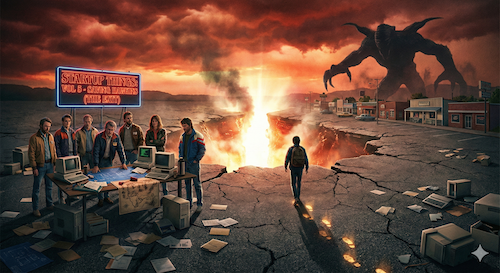
If we follow the trajectory of Stranger Things, the final season isn't about hiding anymore. The rifts are open. The Upside Down is bleeding directly into Hawkins. The sky is red, ash is falling, and the final confrontation is unavoidable. It’s an all-out war to save the town.
This is the "Exit" phase of your startup journey.
The liquidity event—whether an IPO or a strategic acquisition—is often painted as a victory lap. It is not. It is the final boss battle. It is the moment where the private reality of your struggle meets the public reality of the market. The pressure can no longer be contained.
You have to close the gate. And to do that, you have to fight for the legacy of what you built.
I. The Cracking of Hawkins (The Pressure to Liquidate)
At the end of Season 4, giant fault lines ripped through Hawkins. The town can no longer pretend things are normal. The barrier between the worlds has collapsed under the pressure.
A late-stage startup faces identical geological pressure. You may have raised Series C, D, or E funding. Your valuation is in the hundreds of millions, perhaps billions on paper. You have hundreds of employees with stock options they can’t cash. You have early investors breathing down your neck, needing to return capital to their LPs.
The pressure is immense. You can no longer stay private. The ground beneath you is cracking.
In this phase, the founder's job shifts entirely. You are no longer building product; you are engineering an outcome. You have to decide: Do we become the giant (IPO), or do we merge with the giant to save the town (M&A)? Ignoring the cracks is no longer an option; the town will be swallowed whole if you don't act.
II. The War Room (Due Diligence as the Final Battle)
In the final confrontation, the characters always gather in a "war room." They lay out the weapons: baseball bats with nails, wrist rockets, telekinetic powers. They know an army of monsters is coming, and they have one shot to execute the plan.
For a startup founder, the "final battle" is Due Diligence.
Whether you are preparing an S-1 for an IPO or opening a data room for an acquirer, due diligence is grueling psychological warfare. An army of opposing lawyers, accountants, and bankers is about to invade Hawkins. Their sole job is to find every Demodog you hid in the basement over the last five years.
Remember that "hacky" legal agreement you signed in Vol 1? They’ll find it.
Remember the technical debt vines you paved over in Vol 2? They will rip up the floorboards to inspect them.
Remember the culturally toxic salesperson you didn't fire in Vol 3? They will interview them.
This is why so many deals die on the vine. The founders aren't prepared for the intensity of the assault. You need your own army. Your CFO, General Counsel, and investment bankers are your "party" now. If you haven't prepared your weapons (clean books, solid IP assignments, scalable tech), you will be overrun before you even reach the gate.
III. The Ultimate Sacrifice (Letting Go)
The emotional core of Stranger Things is always sacrifice. To save Hawkins, someone usually has to give up something they love. Eleven loses her powers. Hopper loses his freedom. Max loses her sight.
The hardest part of a startup exit isn't the finance; it’s the ego.
To "close the gate" and secure the deal, the founder often has to make the ultimate sacrifice: their identity.
If you IPO, you are no longer the scrappy dictator of a private fiefdom; you are the public face of a regulated entity, answering to quarterly earnings calls and faceless shareholders.
If you are acquired, the sacrifice is often deeper. You have to hand your "baby"—the thing you bled for in the basement—over to someone else. You might become a reluctant VP in a massive org chart. You might watch them shut down your favorite features or reassign your team.
To save Hawkins (the company, the employees' jobs, the investors' capital), you might have to sacrifice your role as its savior. You have to accept that the company must outgrow its need for you.
IV. Legacy: What’s Left of the Town?
When the dust settles after the final battle, what is left of Hawkins? Is it a scorched wasteland, or is it a town that can rebuild and thrive?
A successful exit isn't just about the wire transfer hitting your bank account. That’s just escape. A successful exit is about Legacy.
Did you build something that can survive the transition?
If you sell to a competitor who guts your product and fires your team, you got rich, but you let the Mind Flayer win. You didn't save Hawkins; you sold it out.
The best founders fight during the negotiation phase (the War Room) not just for price, but for provisions that protect the town. They fight for team retention pools, for product autonomy, for the mission to continue under a new banner.
Closing the gate means ensuring that the culture and value you created in the real world are strong enough to stand on their own after you’ve moved on.
The End of the Campaign
The D&D game that started in the basement is finally over. The demogorgons are defeated. The gate is sealed. You look around the table at your party—some are still there, some fell along the way, all are changed forever.
Building a startup, much like surviving Hawkins, is a trauma-bonding experience of epic proportions. It is terrifying, exhausting, and often defies logic.
But if you navigate the static signals, fight back the growth monsters, outsmart the giants, break the trance of burnout, and execute the final battle with integrity... you get to do something very few people ever do.
You get to finish the story on your own terms.
Roll credits.
1st January 2026