


The Death of the Seat-Based License: Pricing for Outcomes in an Automated World
For twenty years, the "seat-based" license has been the undisputed king of SaaS monetization. It was a simple, elegant proxy for value: the more people used the software, the more the customer paid. It aligned perfectly with a world where human labor was the primary driver of productivity.
But in late 2025, the seat-based model is no longer a growth engine—it is a revenue leak.
As we discussed in previous posts, we are moving from "Software as a Tool" (where humans do the work) to "Software as a Service" (SaaService), where AI agents perform the work autonomously.
If your software allows a single "10x Orchestrator" to manage a fleet of agents that do the work of 50 people, and you are only charging for one "seat," you are capturing less than 2% of the value you are creating. You are essentially subsidizing your customer’s massive efficiency gains at the expense of your own margins.
To survive the transition to Agentic AI, founders must kill the seat and embrace Outcome-Based Pricing.
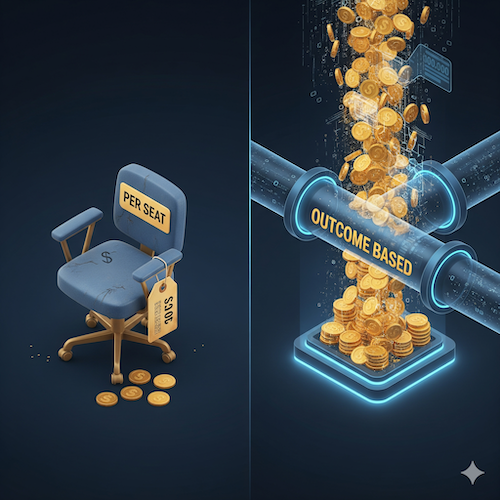
1. The Seat-Based Paradox
The fundamental paradox of AI is that it makes your software more valuable while making your traditional pricing unit less relevant.
In the old world, a CRM company wanted more salespeople using their app. More seats meant more revenue. In the new world, a CRM with integrated AI agents might automate lead scoring, outreach, and scheduling so effectively that a company only needs two people to manage what used to require twenty.
If you charge per seat, your revenue drops by 90% even though your product is now ten times more powerful. This is the Incentive Misalignment Trap: if you make your product better (more automated), you get paid less.
The Margin Squeeze
Furthermore, AI isn't free to run. Every "agentic action" costs you tokens, compute, and API fees. In a seat-based model, a "power user" who deploys a thousand agents can quickly turn a profitable account into a money-loser. You are bearing the variable cost of the AI’s labor while receiving a fixed, flat fee.
2. Moving to the "SaaService" Model
The solution is to stop selling access to a tool and start selling the completion of a task. This is the shift from SaaS to SaaService.
When you price for outcomes, you align your revenue directly with the success of your customer. If your AI agent successfully closes a lead, resolves a support ticket, or optimizes a supply chain, you charge for that specific win.
Three Models for Outcome-Based Pricing
The Credit/Token System: This is the "Utility" model. Customers buy a bundle of credits (e.g., "1,000 Agent Actions per month"). This protects your margins against high API costs and scales as the customer’s automation needs grow.
The Success Fee: This is the "Commission" model. Common in FinTech or SalesTech. You take a small percentage of the money saved or revenue generated by your agents. This is the ultimate "no-brainer" for customers—they only pay when they win.
The Tiered Outcome Model: Instead of "Basic/Pro/Enterprise" based on features, you tier based on throughput.
Tier 1: Up to 500 automated resolutions per month.
Tier 2: Up to 5,000 automated resolutions per month.
3. The Transition Strategy: How to Migrate Without Churn
You cannot simply wake up and double your prices by switching models overnight. It requires a strategic migration.
The "Hybrid" Bridge
Most successful startups in 2025 are using a hybrid model as a bridge. You keep a low, predictable "Platform Fee" (the old seat or base license) to cover your fixed costs and overhead, then add a "Usage" or "Outcome" layer on top.
This allows customers to start small and only pay more as they see the AI actually delivering work. It lowers the barrier to entry while removing the ceiling on your revenue.
Measuring the "Unit of Value"
The hardest part of this shift is defining your Unit of Value. It must be:
Easily Measurable: Both you and the customer can see exactly how many units were consumed.
Directly Correlated to ROI: The customer must feel that paying for more units is a "good problem to have" because it means they are making more money or saving more time.
4. Selling "Labor," Not "Features"
When you move to outcome-based pricing, your sales pitch changes. You are no longer competing with other software; you are competing with human payroll.
If a human junior analyst costs $60,000 a year, and your AI agent can do 90% of their work for $10,000 a year (billed via outcomes), the customer sees a $50,000 saving. You aren't asking them for "software budget"—you are asking for a fraction of their "headcount budget."
This is the ultimate unlock for the "Launch Lean, Fund Slower" founder. By pricing for outcomes, you capture a share of the massive efficiency gains AI provides, ensuring your revenue grows in lockstep with the value you create.
Kill the seat. Charge for the win.
18th December 2025